
Chiropractor Burnout
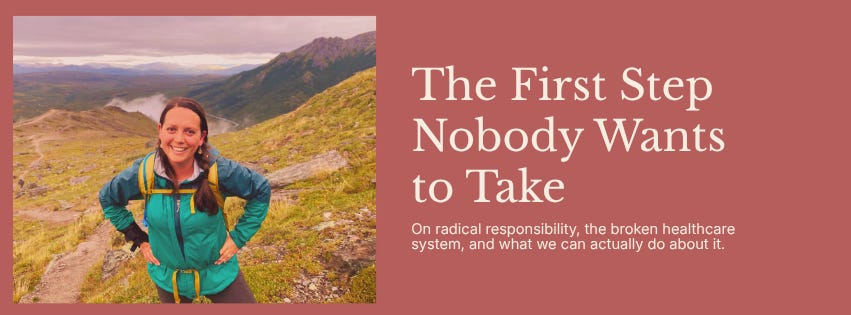
The First Step Nobody Wants to Take
On radical responsibility, the broken healthcare system, and what we can actually do about it.
I spent years being angry at an insurance company.
Rightfully so, I would have told you. An audit. Hundreds of thousands of dollars in claims retroactively recouped as being “overpaid” — claims for care I had already provided, paid staff for, already documented, already submitted by the rules they had given me. The process stretched over months. At the end I was out hundreds of thousands of dollars, with no recourse without deep pockets. It cost me the first iteration of my practice. It cost me financial stability I had spent a decade building. And for a long time, I carried the story that it had happened to me.
The victim narrative is seductive. It’s also partially true. Insurance companies do hold enormous and often arbitrary power over independent practitioners. The US healthcare system is fractured in ways that are structurally real, not imagined. The question of how a payer can decide years later that they overpaid on valid claims is a legitimate one — and someone should keep asking it.
But I no longer live in that story. Not because the grievance wasn’t real. Because staying in it was costing me more than just money. It was costing me my health. My joy. My ability to be present with my family and to continue to serve the community I loved.
After three years of walking away from chiropractic and wallowing in self pity, I learned something that helped me change that story. I learned how to take radical responsibility.
The system is broken. You are part of it.
I’ve been reading David Peter Stroh’s Systems Thinking for Social Change in one of my classes this term. One idea stopped me cold.
Stroh argues that when we approach complex problems using conventional thinking, we often end up perpetuating the very problems we are trying to solve. We seek quick fixes. We assign blame to external forces. And in doing so, we reinforce the idea that responsibility for the mess lives somewhere outside ourselves — in other people, other institutions, other systems (Stroh, 2015).
He’s talking about social change broadly. But when I read it, I thought immediately of healthcare.
We are an industry that speaks fluently about a broken system. Insurance reimbursement that doesn’t reflect the cost of real care. Administrative burden that consumes the hours we should be spending with patients. Corporate medicine that has swallowed independent practice whole. Electronic health records that were designed for billing, not healing. The overworked, under-supported clinician on the edge of leaving the field entirely. The absolute power of insurance companies in dictating care and reimbursement.
All of it is real. None of it is the whole story.
Because we are not outside the system, looking in with clean hands. We are in it. We participate in it. We make choices within it every day — choices that either reinforce the status quo or begin, however incrementally, to disrupt it.
And most of us have never stopped to ask: what is my part in this?
The comfortable place where nothing changes
Blame is not entirely irrational. It locates the problem accurately, at least in part. And it protects us from a more uncomfortable question: what did I choose, and why?
Maybe you built a practice model designed around insurance reimbursement, knowing for years it wasn’t working, because the alternative felt too risky.
Maybe you leaned into the cultural authority that comes with the title “doctor” — the authority that positions you above question, above feedback, above the discomfort of being held accountable — because it was easier than building the kind of leadership that invites it.
Maybe you’ve stayed silent in professional spaces where unethical billing, poor patient outcomes, or compromised integrity were the backdrop — because speaking up has a cost you weren’t ready to pay.
Maybe you’ve never voted, never joined a policy conversation, never engaged with the political process that shapes the very regulations you complain about.
I am not exempt from any of this. I did most of it. I also spent years blaming the audit, the system, the circumstances — and none of that blame moved me an inch closer to building what I actually wanted.
Research on physician burnout consistently links external locus of control — the belief that outcomes are determined by forces outside of oneself — with higher rates of emotional exhaustion and depersonalization (Hassed et al., 2009; Maslach & Leiter, 2016). The practitioners who fare better, who sustain longer, who rebuild from burnout rather than disappear into it, tend to share one distinguishing trait: they believe their choices matter.
Not in a naive, “mindset over matter” way. In a structural way. They see the agency that still exists within the constraints.
What radical responsibility actually means
Let me be clear about what this is not.
Radical responsibility is not self-blame. It is not the suggestion that structural injustice is your fault, or that if you just worked harder, thought more positively, or built a better morning routine, the insurance system would reform itself.
It is not an invitation to internalize what should be externalized.
What it is: the decision to locate what you actually have control over, and to stop ceding that territory to the story that you have none.
Stroh describes the shift from conventional to systems thinking as a move from placing responsibility on external elements to recognizing our role in shaping current circumstances (Stroh, 2015). That doesn’t mean taking on guilt. It means taking on authorship.
There is a difference between those two things, and it matters enormously.
Guilt says: this is my fault, and I am bad.
Authorship says: this is my story, and I can write the next chapter differently.
The insurance audit that led to my bankruptcy could have — and did, for years — end the story with me as a casualty of a broken system. Which was true. And it also ended with me returning as the hero of my story three years later, building the practice I had always actually wanted but never let myself design, because I had been too busy building toward someone else’s definition of success confined in a system of regulations and red tape.
The moment that shifted wasn’t when the circumstances changed. It was when I stopped waiting for the circumstances to change before I could move.
The question that opens the door
So here is the question I want to leave you with:
What can you be responsible for?
Not everything. Not the insurance monopoly. Not the hospital consolidation that has swallowed independent practices in your market. Not the decades of medical culture that equated burnout with dedication and called it virtue.
But something. There is always something.
Maybe it’s the way you’ve stayed complacent in a model that stopped working years ago because rebuilding felt like failure.
Maybe it’s the way you’ve never fully confronted what you compromised to fit inside the system — and what that cost your patients, your team, or you.
Maybe it’s that you’ve been waiting for the system to become more equitable before you practice equitably — and in the meantime, entire communities are sitting outside your waiting room.
Maybe it’s simply that you’ve been telling yourself there’s nothing you can do — and in doing so, you’ve handed your power over to the forces you resent.
Taking responsibility for your part does not mean condoning the rest of it. It does not mean accepting that the system is fine, or that your anger at it is misplaced. You can have both: this is broken, and I am not powerless within the brokenness.
That is not admitting defeat. That is taking a stand from the only place change actually starts.
From victim to author
The trauma work I’ve done, the leadership research I’ve studied, the organizational psychology I’ve unpacked — they all point to the same threshold.
You cannot move from victimization into agency without passing through responsibility first.
Not because the victim narrative is a lie. But because it is not a complete story. And incomplete stories cannot generate new ones.
Healthcare needs practitioners who are willing to be authors of something different — not just frustrated critics of what currently exists. That work starts inside, before it shows up in policy rooms or on ballots or in the models we build.
It starts with the question: what am I responsible for here?
And then the harder one: what am I going to do about it?
I’d love to know, what are you going to take responsibility for and stop ceding your power to in your practice?
References
Hassed, C., Lisle, S., Sullivan, G., & Pier, C. (2009). Enhancing the health of medical students: Outcomes of an integrated mindfulness and lifestyle program. Advances in Health Sciences Education, 14(3), 387–398. https://doi.org/10.1007/s10459-008-9125-3
Maslach, C., & Leiter, M. P. (2016). Understanding the burnout experience: Recent research and its implications for psychiatry. World Psychiatry, 15(2), 103–111. https://doi.org/10.1002/wps.20311
Stroh, D. P. (2015). Systems thinking for social change: A practical guide to solving complex problems, avoiding unintended consequences, and achieving lasting results. Chelsea Green Publishing.
If your practice is running you instead of the other way around, start here.
Take the free 3-minute burnout quiz