Rooted Leadership
What the Funnel Cakes Taught Me About Organizational Integrity
Bringing organizational context to the current struggles of Life University
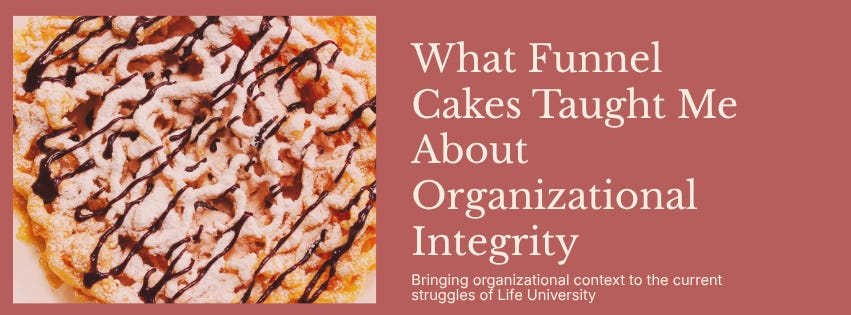
Every December at my chiropractic college, thousands of visitors came to campus for Lights of Life, a holiday light display. Genuinely beautiful. And every year, alongside the lights, someone set up booths selling deep-fried candy bars and funnel cakes, while people smoked cigarettes directly under our no-smoking signs. It happened when I was a student there between 2008-2012, and it’s still happening today.
I don’t hate funnel cakes. I hate them at a university that spent every quarterly assembly telling us we were creating a global paradigm shift in wellness.
I got in trouble more than once as a student over this. I wrote for the school paper, and at one point I more or less declared war on funnel cakes in print. Not because fried dough is the enemy. Because there’s a time and place, and a campus built on a wellness mission to create a global paradigm shift in how the world perceived wellness wasn’t it. Nor was the fight the student body had with the same administration to keep vending machines out of our hallways. The students didn’t win.
The gap that erodes trust
There’s a concept from organizational psychology that puts words to exactly what I was reacting to before I had the language for it. People and organizations carry two theories at once. There’s the one they state out loud when asked how they will behave, called an espoused theory. And there’s the one that guides their behavior, which can only be seen by watching what happens, called the theory-in-use. What researchers found is rather uncomfortable to acknowledge: most of us carry a significant distance between the two. We don’t always practice what we preach, however sincerely we mean it.
It’s not a character flaw unique to one dishonest university. It’s what happens anywhere the vision gets separated from the daily decisions running the place.
When a system stops learning
Espoused theory versus theory-in-use explains the individual gap. But there’s a systems-level version of the same problem that often gets discussed but isn’t always clearly understood.
Systems thinkers describe organizational dysfunction less as a failure of intention and more as a failure of feedback. A healthy system, one that’s genuinely learning, surfaces the gap between what it says it wants and what it’s producing, and treats that gap as information. An unhealthy system buries the gap instead. It manages the announcement rather than the outcome.
Donella Meadows, one of the earliest and clearest voices in systems thinking, put it plainly: systems learn through feedback loops, and the fastest way to break a system is to sever the connection between what it does and what it hears back about what it did. When a leadership team keeps making decisions that produce the same crisis, year after year, that’s usually not a mystery. It’s a system that’s stopped listening to its own feedback.
And Otto Scharmer, whose Theory U work looks at organizational change through the lens of collective leadership, points to a particular failure mode: organizations that keep downloading old patterns of thinking instead of sensing what the moment is asking of them. He describes this as a kind of blind spot, where people inside a system genuinely can’t see the place their own decisions are coming from, and so they keep producing outcomes nobody consciously wants.
That, more than any single funnel cake, is what stuck with me from my time at Life. It wasn’t that the vending machines, the funnel cakes and the vision statement disagreed. It’s that nobody in a position to close that gap seemed to be listening to the fact that it existed.
Why I’m thinking about this again now
I’m writing this at a moment when my alma mater is back in real trouble that they have been circling around for decades. Life University has spent the last two years navigating an accreditation probation tied to licensing-exam pass rates, a financial squeeze significant enough to trigger staff layoffs and the loss of its 401(k) match, and a bond rating credit agencies have downgraded into speculative territory with a negative outlook. Alumni and former faculty have publicly raised concerns about whether the institution is being honest with its own community about how it got here, and who is steering the response.
I don’t know every detail of what’s happening inside those decisions right now, and I’m not going to pretend I do. But I recognize the shape of it. It’s the same shape as the funnel cakes and vending machines, just with higher stakes. An institution that teaches integrity as a daily discipline, alignment between what you say and what you do, is again being asked whether its leadership is willing to look honestly at the gap between the two. Whether this becomes a story about a system that finally learns, or one more chapter in a system managing its way around the feedback instead of listening to it, isn’t something I can answer from here. But it’s exactly the question this whole article is about.
Where I’ve had to look at my own gap
I’ve sat with this in my own practice too. Since returning to practice in 2024, I’ve been committed to staying out of the insurance racket. As I’ve explored being all cash, I built a subscription model with an unlimited visit option because it sounded generous, in line with everything I say about non-transactional care and if I’m being honest covered a self worth wound in the name of service. A few weeks ago I asked for feedback from those who had joined that model of care in practice. What they told me was that they were very happy, but honestly, that unlimited felt like a trap wearing a gift’s clothing. More pressure to use it up than freedom to use it as needed.
My espoused theory said generosity. What I was practicing was creating pressure I never intended. I reworked my subscription model to be based on frequency of care, not number of visits. Not because the original vision was wrong, but because I finally looked at what was really happening on a Tuesday afternoon instead of what I’d meant to happen. That’s a feedback loop working the way it’s supposed to.
Not just having a mission statement framed on the wall. Auditing whether your practice, your Tuesdays, your fee schedule tell the same story your mission does, and being willing to hear it when they don’t.
It’s also asking this question of our profession and the organizations that belong to it.
The invitation
If something in your practice, or in this profession, feels dishonest to you in a way you can’t quite put your finger on, I don’t think you’re imagining it. I think you’re standing in the gap between what is being said and what is being practiced. Noticing that gap is the beginning of finding our way back to being in integrity and learning from the feedback loop rather than hiding from it.
Where is your espoused theory colliding with what you actually put into practice? Or where do you see it in the profession as a whole? Not the version you’d say out loud if someone asked. The version a stranger would see if they watched a random Tuesday.
That’s the honest place to start.
References
Argyris, C., & Schön, D. A. (1974). Theory in practice: Increasing professional effectiveness. Jossey-Bass.
Meadows, D. H. (2008). Thinking in systems: A primer. Chelsea Green Publishing.
Scharmer, C. O. (2009). Theory U: Leading from the future as it emerges. Berrett-Koehler Publishers.
Stroh, D. P. (2015). Systems thinking for social change: A practical guide to solving complex problems, avoiding unintended consequences, and achieving lasting results. Chelsea Green Publishing.
If your practice is running you instead of the other way around, start here.
Take the free 3-minute burnout quiz